Batch vs Streaming Architecture, Choosing the Right Approach
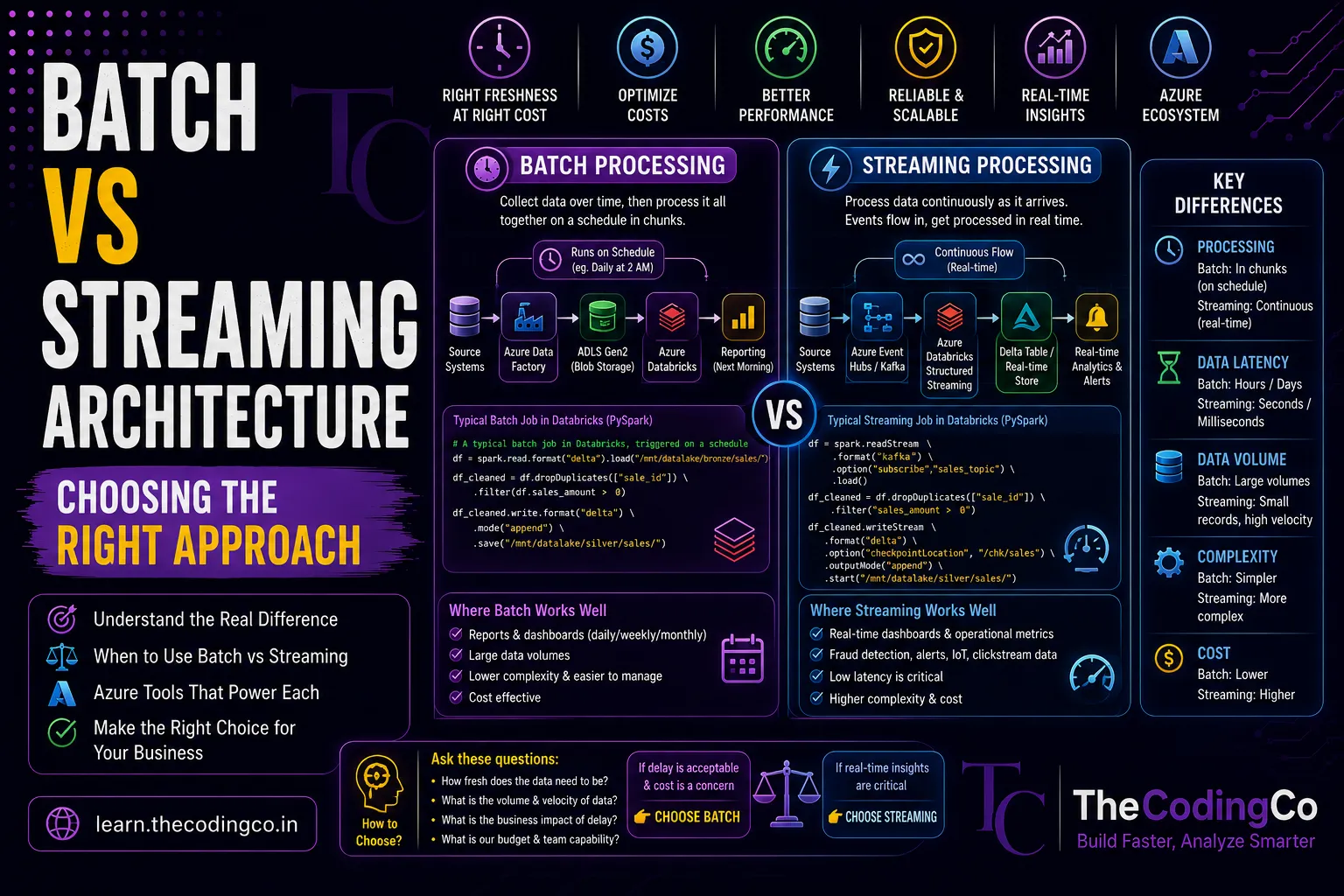
The real difference between batch and streaming pipelines, when each one actually makes sense, and how this decision plays out with Azure tools.
The question behind the question
Whenever someone asks whether to use batch or streaming, what they are really asking is how fresh does this data need to be, and how much complexity and cost are we willing to take on to get that freshness.
That framing matters, because streaming is not automatically the better choice just because it sounds more advanced. A lot of data engineering time gets wasted building a real time pipeline for a report that genuinely only needed to update once a day. So before getting into the technical differences, it is worth understanding that this is fundamentally a business decision dressed up as a technical one.
Batch processing
Batch processing means collecting data over a period of time, then processing all of it together in one go, usually on a schedule. Think of it as processing data in chunks, like once every hour, or once every night.
A typical batch setup on Azure looks like this. Azure Data Factory has a pipeline scheduled to run every night at 2 AM. It pulls the entire day's new records from a source database, drops them into Azure Data Lake Storage Gen2, and then a Databricks notebook processes that data, cleaning it and writing it into a Delta table for reporting the next morning.
# A typical batch job in Databricks, triggered on a schedule
df = spark.read.format("delta").load("/mnt/datalake/bronze/sales/")

df_cleaned = df.dropDuplicates(["sale_id"]) \
               .filter(df.sales_amount > 0)

df_cleaned.write.format("delta") \
    .mode("append") \
    .save("/mnt/datalake/silver/sales/")
This job runs, finishes, and then sits idle until the next scheduled run. Nothing about this is happening continuously.
Where batch works well Batch is the right choice when a delay of a few hours, or even a full day, does not actually hurt anyone. Most business reporting fits this description. A daily sales dashboard, a weekly inventory report, a monthly finance summary, none of these need data updated every second, and building them as real time pipelines would add a lot of unnecessary complexity for no real benefit.
Batch is also simpler to build, test, and debug. If something goes wrong, you are looking at one run that failed, not trying to trace an issue through a constant stream of events.
Streaming
Streaming processing means handling data continuously, as it arrives, often within seconds of it being generated, rather than waiting to collect a batch first.
A typical streaming setup on Azure might look like this. Events come in through Azure Event Hubs, maybe from a website tracking user clicks in real time. Azure Databricks, using Structured Streaming, reads from that event hub continuously, processes each micro batch of incoming events, and writes the results into a Delta table almost immediately.
# A simplified structured streaming setup reading from Event Hubs
df_stream = (spark.readStream
    .format("eventhubs")
    .options(**eh_conf)
    .load())

df_parsed = df_stream.selectExpr("CAST(body AS STRING) as json_data")

query = (df_parsed.writeStream
    .format("delta")
    .outputMode("append")
    .option("checkpointLocation", "/mnt/datalake/checkpoints/clickstream/")
    .start("/mnt/datalake/silver/clickstream/"))
Unlike the batch job, this keeps running continuously, processing new data as it shows up, rather than finishing and going idle.
Where streaming works well Streaming makes sense when the value of the data drops sharply the older it gets. Fraud detection is a common example, where catching a suspicious transaction seconds after it happens is far more useful than catching it the next morning. Live operational dashboards, like monitoring server health or tracking live user activity during a product launch, are another good fit. Anything involving alerting on events as they happen, like an IoT sensor detecting equipment failure, also needs streaming, since waiting for a nightly batch could mean real damage has already occurred.
The trade offs nobody skips mentioning, but rarely explains well
- Streaming pipelines are genuinely harder to build and maintain, and it is worth understanding specifically why, not just accepting that as a fact.
- Debugging is harder because there is no clean start and end to a job run. You are dealing with a continuous flow, and issues like data arriving out of order, or a brief network interruption causing a gap, require handling that a batch job simply does not need to think about.
- Cost is usually higher, since a streaming pipeline needs compute running continuously rather than spinning up briefly for a scheduled batch job. A Databricks cluster processing a nightly batch runs for maybe twenty minutes. A streaming cluster runs all day, every day.
- Handling late or out of order data becomes a real design problem in streaming, usually solved using watermarking, which is essentially a rule for how long the system should wait for late data before considering a time window closed. Batch processing rarely needs to think about this at all, since by the time a batch job runs, all the relevant data has typically already arrived.
A middle ground worth knowing about
A lot of real world Azure setups do not pick purely one or the other. A common pattern is micro batching, where Structured Streaming is configured with a trigger interval, like every five minutes, rather than processing every single event instantly.
query = (df_parsed.writeStream
    .format("delta")
    .outputMode("append")
    .trigger(processingTime="5 minutes")
    .option("checkpointLocation", "/mnt/datalake/checkpoints/clickstream/")
    .start("/mnt/datalake/silver/clickstream/"))
This gives you data that is fresh within a few minutes, without carrying the full operational complexity and cost of true second by second streaming. A lot of teams find this hits a reasonable balance for use cases that need to be fairly current, but not necessarily instant.
How to actually decide
Rather than defaulting to whichever sounds more impressive on a resume, ask a simple question. If this pipeline broke for six hours, would anyone outside the data team even notice or care. If the honest answer is no, batch is almost certainly the right call. If the answer is yes, and especially if the answer is people would notice within minutes, streaming or micro batching starts to make real sense.
Interview angle
If asked to compare these, avoid just listing definitions. Bring up the cost and complexity trade off directly, since that shows you understand this is an engineering decision with real consequences, not just a technical preference. If asked when you would choose streaming over batch, a strong answer references the actual business need for freshness, like fraud detection or live monitoring, rather than saying streaming is simply the more modern or better option.
Quick recap
Batch processing handles data in scheduled chunks and works well for most standard reporting needs, offering simplicity and lower cost. Streaming processes data continuously as it arrives, and is necessary when the value of data depends heavily on how quickly it is acted on, like fraud detection or live monitoring, but comes with real added complexity and cost. On Azure, this usually plays out as Azure Data Factory and scheduled Databricks jobs for batch, and Azure Event Hubs with Databricks Structured Streaming for real time or near real time needs, with micro batching often serving as a practical middle ground.