Azure vs AWS vs GCP for Data Engineers, A Practical Comparison
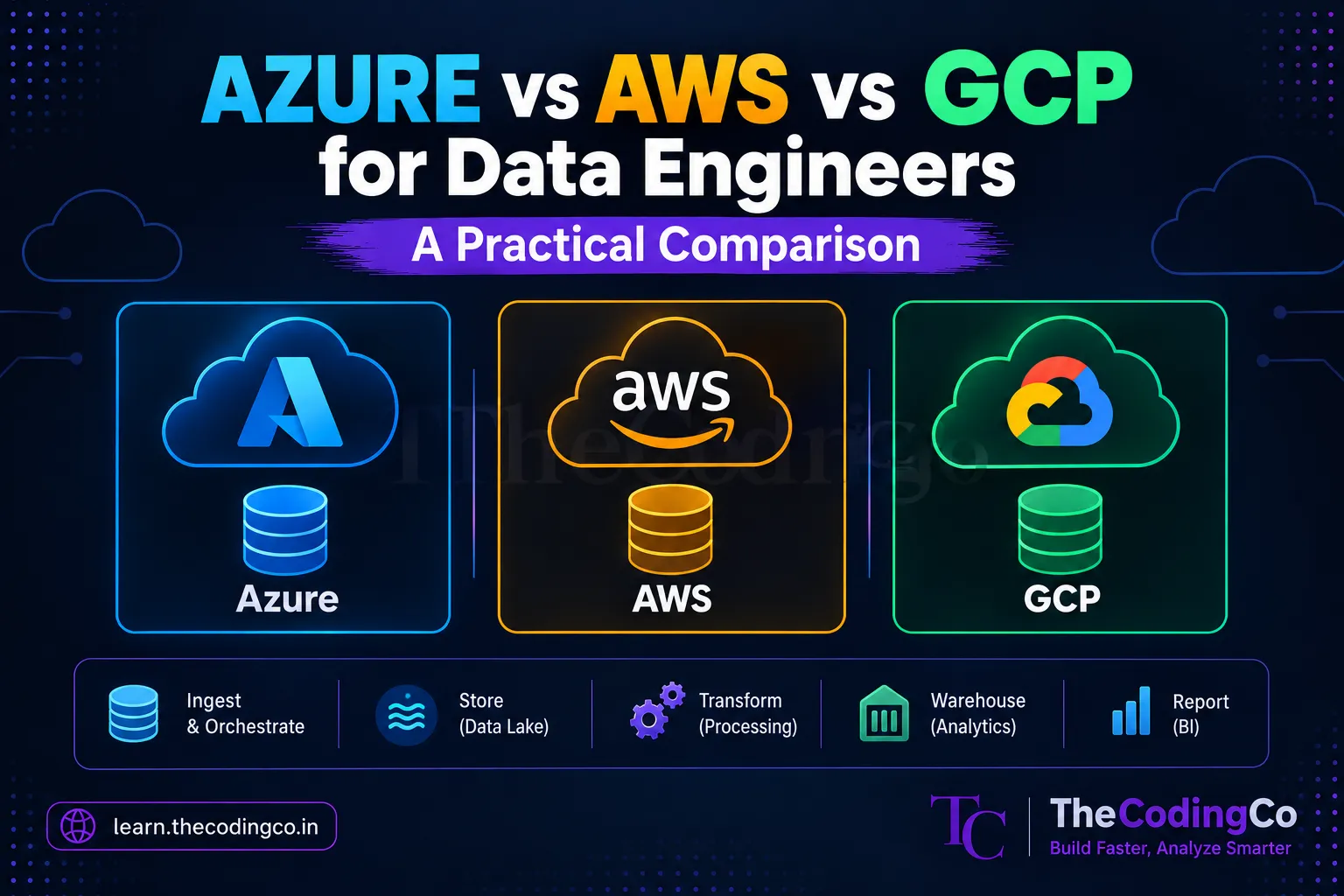
How Azure, AWS, and GCP actually differ for data engineering work, mapped tool by tool, and what this means if you are choosing which platform to focus on.
Why the tool names matter less than the underlying concepts
The good news for anyone learning one of these platforms deeply is that the core concepts of data engineering do not really change between clouds. You still need to ingest data, store it somewhere reliable, transform it at scale, and serve it to reporting tools. What changes between Azure, AWS, and GCP is mainly the specific service names and how those services are wired together, not the fundamental ideas.
This is genuinely useful to know if you are, say, deep into Azure and worried that AWS knowledge is a completely separate skill set. It mostly is not. Once you understand what a service does conceptually, mapping that to an equivalent service on another cloud is usually far faster than learning the concept from scratch.
Mapping the core services side by side
| Purpose | Azure | AWS | GCP |
|---|---|---|---|
| Data movement and orchestration | Azure Data Factory | AWS Glue, Step Functions | Cloud Composer, Dataflow |
| Object and data lake storage | Azure Data Lake Storage Gen2 | Amazon S3 | Google Cloud Storage |
| Large scale processing | Azure Databricks, Synapse Spark Pools | AWS Glue, EMR, Databricks on AWS | Dataproc, Databricks on GCP |
| Data warehouse | Azure Synapse Dedicated SQL Pool | Amazon Redshift | BigQuery |
| Streaming ingestion | Azure Event Hubs | Amazon Kinesis | Pub/Sub |
| BI and reporting | Power BI | QuickSight | Looker |
| Access and identity | Azure Active Directory, RBAC | AWS IAM | Cloud IAM |
This table is a rough map, not a perfect one to one comparison, since these tools do not always behave identically even when they serve a similar role. But it is a genuinely useful starting point if you already know one cloud and are trying to orient yourself on another.
Where Azure actually stands out
Azure's biggest strength for data engineering right now is how tightly Azure Databricks is integrated into the platform, along with strong Power BI integration, which makes the whole path from raw data to a finished business dashboard feel unusually smooth compared to stitching together separate tools on other clouds. If your organization is already using Microsoft tools broadly, like Office 365, Power BI, or Dynamics, Azure tends to fit naturally into that existing ecosystem rather than requiring a lot of separate integration work.
Azure also has a genuinely strong presence in industries like banking, insurance, and government, particularly outside the US, partly due to compliance certifications and enterprise relationships Microsoft has built over decades. This matters practically, since a lot of data engineering roles in these industries specifically require Azure experience rather than treating cloud platforms as interchangeable.
Where AWS actually stands out
AWS has the largest overall market share and the widest breadth of individual services, which means more granular control if you need it, but also more decisions to make when architecting a solution, since there is often more than one AWS service that could technically do the job.
AWS tends to be common at tech companies and startups that built their infrastructure early, since AWS was the dominant cloud platform for a long time before Azure and GCP caught up significantly. A lot of tech industry data engineering roles, especially outside of large traditional enterprises, lean toward AWS for this reason.
Where GCP actually stands out
GCP's standout strength is BigQuery, which is a genuinely different kind of data warehouse experience compared to Synapse or Redshift, being fully serverless and often noticeably fast for large scale analytical queries without needing to manage cluster sizing at all. Companies that are heavily analytics focused, or that started as data driven from day one, sometimes gravitate toward GCP specifically because of BigQuery's reputation.
GCP tends to have a smaller overall market share compared to Azure and AWS, which in practice means fewer job postings overall, though this varies a lot by region and industry, with GCP being notably stronger in certain sectors like ad tech and some parts of the tech industry.
What this means if you are choosing where to focus
- If you are early in your career, trying to learn all three clouds at once tends to backfire, leaving you with shallow knowledge of everything and genuine depth in nothing. Interviewers can usually tell the difference between someone who has actually built real pipelines on a platform versus someone who watched a few tutorials across three different clouds.
- A more practical approach is picking one cloud, based mainly on what is actually in demand in your target job market or industry, and going genuinely deep on it. Once you have real depth in one platform, picking up a second one later is meaningfully faster, since you are mostly mapping familiar concepts onto new service names rather than learning data engineering from scratch again.
- For someone specifically targeting Azure, this usually means Azure Data Factory for orchestration, Azure Data Lake Storage Gen2 for storage, Azure Databricks for processing, and enough of Azure Synapse Analytics to understand where it fits for reporting workloads, going deep enough to actually build and debug real pipelines, not just recognize the service names.
A note on multi cloud reality at real companies
It is worth knowing that plenty of real companies are not purely single cloud in practice, sometimes for genuine technical reasons, sometimes just due to how the company grew over time, like acquiring another company that happened to build on a different cloud. Being aware that multi cloud environments exist is useful, but this is not usually where a beginner should focus early learning time. Depth in one platform first, awareness of others second, tends to be the more effective order.
Interview angle
If asked why you chose to focus on Azure specifically, tying your answer to something concrete, like the strength of Power BI integration for reporting heavy work, or the prevalence of Azure in a specific industry you are targeting, sounds more genuine than a vague answer about it just being a major cloud provider. If asked whether you know AWS or GCP as well, being honest about the depth of your knowledge, while pointing out that the underlying concepts transfer well between clouds, shows self awareness rather than overstating unfamiliar territory.
Quick recap
Azure, AWS, and GCP all solve the same fundamental data engineering problems, just with different service names and slightly different strengths. Azure stands out for its tight Databricks and Power BI integration and strong presence in enterprise and regulated industries. AWS offers the broadest range of services and a strong presence in tech companies that built early on cloud infrastructure. GCP stands out mainly through BigQuery's serverless analytics performance. For someone building a career, going genuinely deep on one platform, chosen based on your target job market, tends to be far more valuable than shallow, spread out knowledge across all three.