Common Myths About Data Engineering That Beginners Believe
A few misconceptions that tend to trip up people early in their data engineering journey, and what the reality actually looks like once you are working on real pipelines.
Why these myths spread so easily
A lot of what gets written about data engineering online comes from either very polished tutorials that skip the messy parts, or job postings written by people who are not actually data engineers themselves. Between those two sources, some genuinely misleading ideas end up spreading, and they can shape how someone approaches learning in ways that end up wasting time. Here are the ones that come up most often.
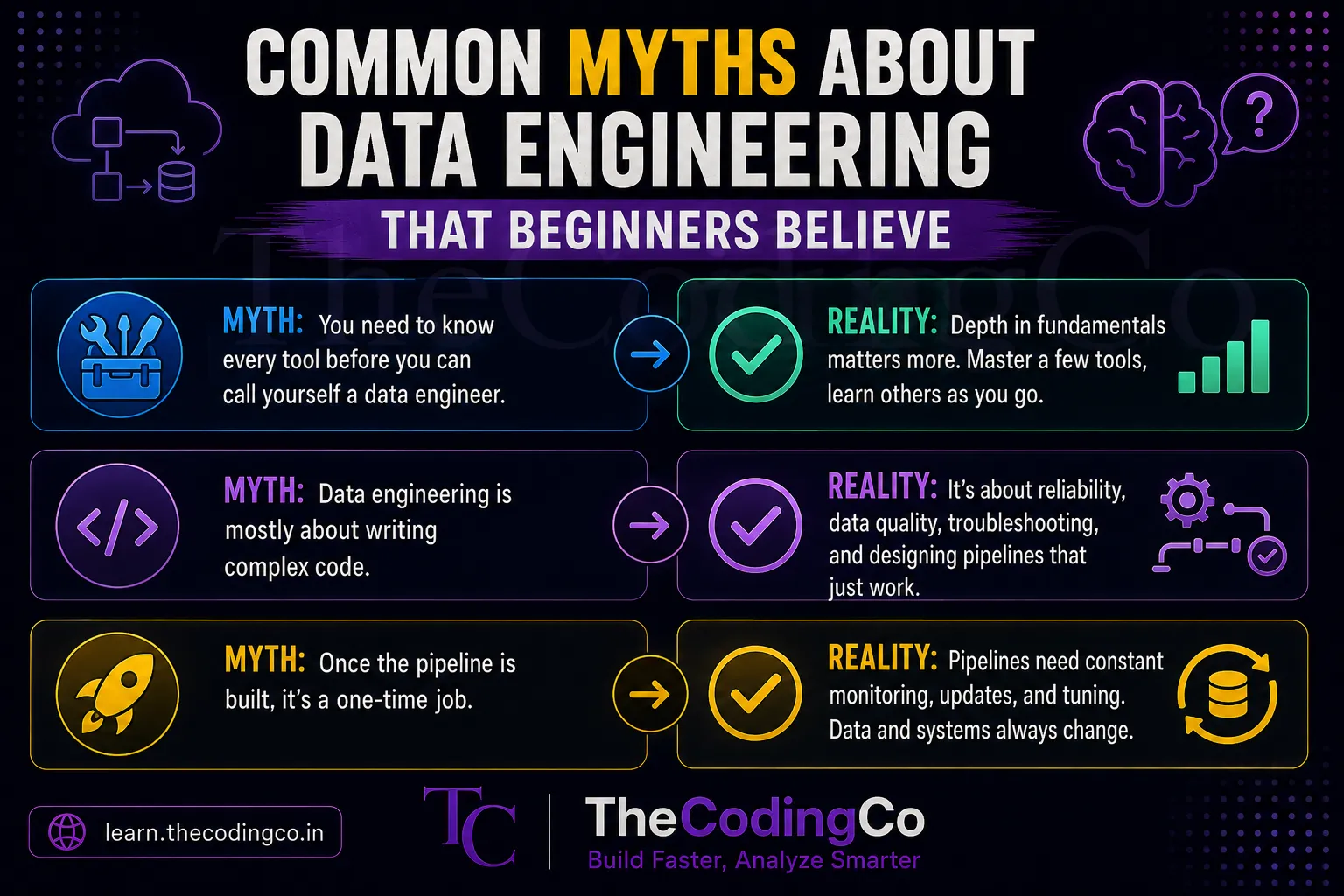
Myth: you need to know every tool before you can call yourself a data engineer
- This is probably the most common one, and it is also the most discouraging for beginners. Scroll through enough job postings and you will see a wishlist including Azure Data Factory, Databricks, Synapse, Kafka, Airflow, Terraform, and half a dozen other tools, all in a single posting.
- The reality is that most companies are not actually using all of these at once, and most experienced data engineers have deep knowledge of a handful of tools, with surface level familiarity with a few others they picked up along the way as needed. A job posting listing fifteen tools is often just describing everything the team has ever touched across multiple projects, not a strict requirement for one person to master before applying.
- What actually matters more is depth in the fundamentals, like SQL, understanding how Spark works, and being genuinely comfortable with whichever cloud platform you are working with, in this case Azure. Specific tool experience tends to transfer faster than people expect once those fundamentals are solid, since most orchestration tools and processing engines share similar underlying concepts.
Myth: data engineering is mostly about writing complex code
- A lot of tutorials focus heavily on writing PySpark transformations and clever SQL queries, which gives the impression that the job is primarily about clever code. In practice, a significant portion of real data engineering work is about things that have very little to do with writing complex logic at all.
- This includes tracing why a pipeline that worked fine for months suddenly started failing, which is often not a code problem at all but a change in the source data that nobody warned you about. It includes writing documentation that someone else can actually follow six months later when they are debugging your pipeline at two in the morning. It includes having conversations with people outside the data team to understand what a business actually needs before building anything.
- The code itself is often the more straightforward part. The harder parts tend to be around reliability, communication, and understanding the actual business context well enough to build the right thing in the first place.
Myth: more data automatically means more value
- There is a common assumption that collecting and storing as much data as possible is inherently good, and that a data engineer's job is partly to maximize how much data gets captured and retained.
- In reality, unused or poorly understood data sitting in storage does not create value on its own, and it often creates real problems. It costs money to store and process, even at Azure's relatively cheap storage rates. It creates confusion when multiple people are unsure whether a table is still actively used or safe to modify. And it can create actual compliance risk, especially with personal or sensitive data that is being retained longer than necessary without a clear reason.
- A more accurate way to think about this is that the value comes specifically from data that is well understood, reliably maintained, and actually being used by someone downstream, not from the raw volume sitting in a data lake. Part of a mature data engineering practice actually involves deprecating and cleaning up data and pipelines that are no longer needed, not just constantly adding more.
Myth: once a pipeline is built, the work is basically done
- This one tends to surprise people who come from a background where finishing a project feels like the end of the task. In data engineering, building the pipeline is really just the beginning of its lifecycle.
- Source systems change their schemas without warning. Data volume grows over time, and a pipeline that ran fine on last year's data volume might start timing out or running unacceptably slow a year later. Business logic changes, meaning a transformation that was correct when it was written might silently become wrong after a business rule changes and nobody updates the pipeline to reflect it.
- A realistic way to think about a pipeline once it is deployed is that it now requires ongoing attention, not that it is finished and can be forgotten. This is part of why monitoring, alerting, and documentation matter as much as they do, since they are what make this ongoing maintenance manageable rather than something that quietly breaks and goes unnoticed.
Myth: data engineering does not require understanding the business
- There is a version of this myth that treats data engineering as a purely technical role, disconnected from actually understanding what the business does or why certain numbers matter. Under this view, a data engineer just needs to move data from A to B correctly, and understanding what that data actually represents is someone else's job.
- In practice, this leads to real problems. Building a pipeline correctly according to a technical specification does not help much if that specification was based on a misunderstanding of how the business actually defines a metric. A data engineer who understands, for example, what actually counts as a completed order versus a cancelled one, catches modeling mistakes early that someone purely focused on the technical mechanics would miss entirely.
- The deepest business understanding is usually expected more from analytics engineers or analysts, but a data engineer who has zero grasp of what the data actually represents tends to build pipelines that are technically correct but practically wrong in subtle ways that only get discovered much later.
Myth: you need a formal computer science degree to get into this field
- This one keeps a lot of capable people from even trying. While a computer science background can certainly help, especially with understanding things like algorithms and system design, plenty of working data engineers come from other backgrounds entirely, including business analytics, statistics, or even completely unrelated fields, having picked up SQL, Python, and cloud platform skills through self study or a career transition.
- What actually matters far more than the degree on paper is being able to demonstrate real, practical skill, whether that is through actual work experience, a solid portfolio of projects that show genuine understanding rather than copied tutorials, or simply performing well when tested during an interview process.
What this actually means for someone starting out
If you are early in learning this field, it helps to let go of the idea that you need to master every tool before you are ready, that the job is purely about writing impressive code, or that finishing a pipeline means the work is done. A more accurate mental model treats data engineering as an ongoing practice of building reliable systems, understanding the business context behind the data, and maintaining and adapting those systems as things inevitably change over time.
Interview angle
If a question during an interview touches on any of these areas, like how you handle a pipeline after it goes to production, or how you think about data retention, giving an answer that reflects the reality rather than the common myth tends to stand out. Mentioning ongoing monitoring and maintenance rather than treating deployment as the finish line, or mentioning the cost and risk of unused data rather than treating more data as automatically good, shows a more mature understanding of the role than someone repeating the more common but less accurate assumptions.
Quick recap
You do not need to master every tool on a long job posting to be a capable data engineer, deep fundamentals matter more than broad but shallow tool familiarity. The job is not purely about writing complex code, a large part of it involves debugging, communication, and understanding business context. More data does not automatically mean more value, and unused data carries real cost and risk. A pipeline going live is the start of its lifecycle, not the end. And while a computer science degree can help, it is not a strict requirement for building a genuine career in this field.