Data Engineer vs Analytics Engineer, What Is the Actual Difference
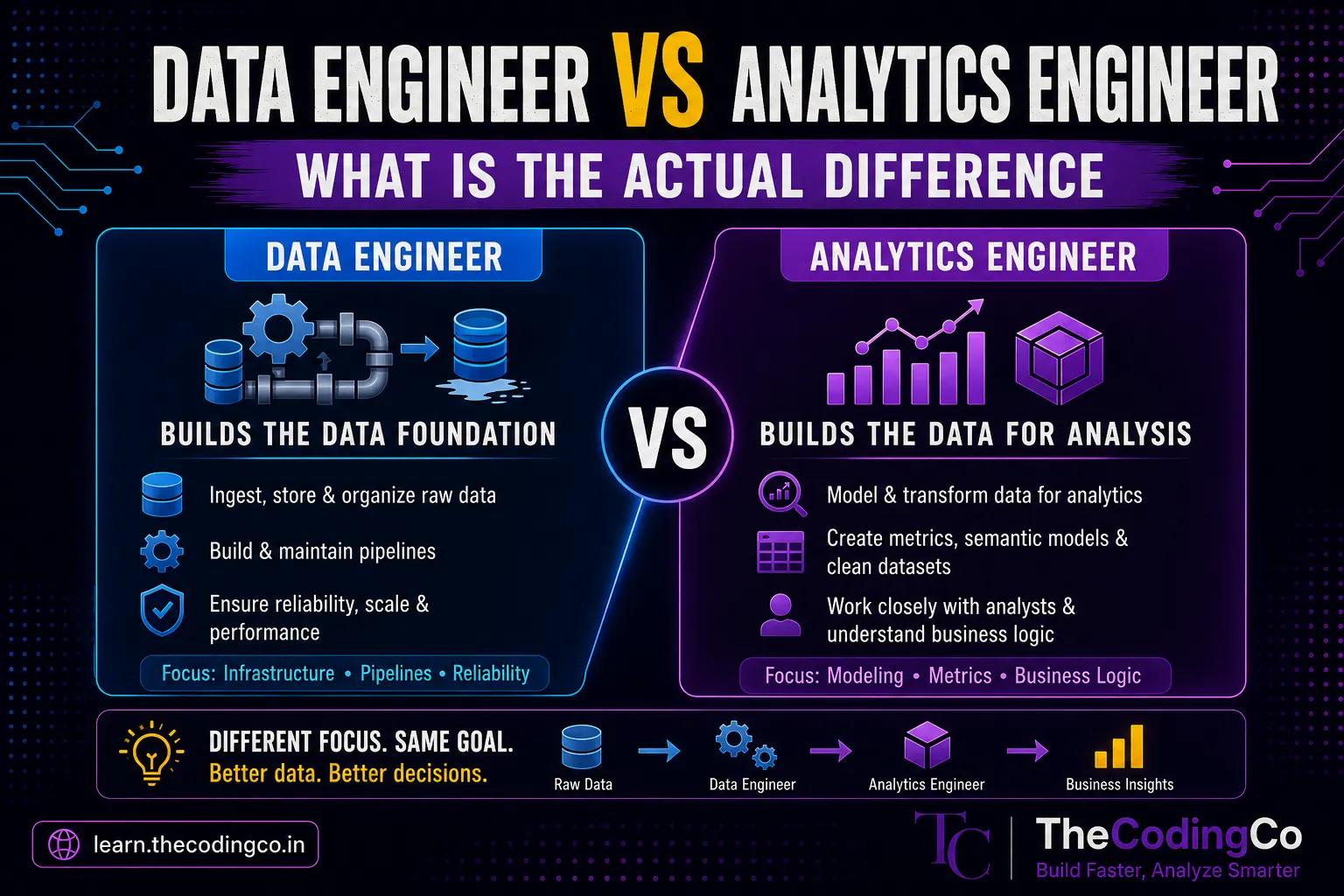
Analytics engineer is a newer title that keeps showing up alongside data engineer, and this breaks down where the actual boundary sits between the two.
Why this title started showing up everywhere
If you have been job hunting recently, you have probably noticed analytics engineer showing up more and more, sometimes looking almost identical to a data engineer posting, and sometimes looking closer to a data analyst posting. This title is genuinely newer than data engineer, and it emerged for a fairly specific reason worth understanding.
For a long time, data engineers were expected to do two very different kinds of work. Building the actual infrastructure and pipelines that move raw data into a data lake or warehouse, and then also writing the business logic transformations that turn that raw data into something an analyst can report on, like calculating customer lifetime value or building a clean sales table with proper business rules applied.
Those two things require pretty different skill sets. One is closer to software and infrastructure engineering. The other is closer to understanding the business and writing solid SQL. As companies grew and this became too much for one role to handle well, the analytics engineer title emerged to specifically own that second part.
What a data engineer owns
- The data engineer's responsibility sits earlier in the pipeline, and leans more toward infrastructure and reliability. This usually means building the systems that pull raw data in from source systems, handling things like connecting to APIs and databases, managing how data lands in storage, and making sure pipelines run reliably, scale properly, and recover gracefully when something fails.
- On Azure, this looks like building Azure Data Factory pipelines to ingest data from various sources, writing PySpark jobs in Azure Databricks to handle large scale processing, and managing how data flows into Azure Data Lake Storage Gen2 in a structured way, often through a Bronze and Silver layer.
# A data engineer's work often looks like this,
# handling raw ingestion and basic cleaning at scale
df_raw = spark.read.format("json").load("/mnt/datalake/bronze/api_events/")

df_cleaned = (df_raw.dropDuplicates(["event_id"])
                     .filter(df_raw.event_type.isNotNull()))

df_cleaned.write.format("delta").mode("append").save("/mnt/datalake/silver/api_events/")
The data engineer cares a lot about things like pipeline reliability, scalability, and infrastructure cost, since they are the ones dealing with what happens when data volume grows tenfold, or when a source system suddenly changes its schema without warning.
What an analytics engineer owns
- The analytics engineer's responsibility sits closer to the business side, working with data that has already been ingested and reasonably cleaned by a data engineer, and turning it into well modeled, trustworthy tables specifically designed for reporting and analysis.
- This usually means writing SQL based transformations that apply real business logic, like defining what actually counts as an active customer, calculating metrics like monthly recurring revenue correctly, and organizing data into a clean star schema with fact and dimension tables that analysts and business users can query easily.
- A lot of analytics engineering work happens using a tool called dbt, short for data build tool, which lets you write transformations as SQL models, test them, and document them in a structured, version controlled way.
-- A typical dbt model an analytics engineer might write,
-- transforming cleaned data into a business ready table
select
    customer_id,
    count(order_id) as total_orders,
    sum(order_amount) as lifetime_value,
    case
        when count(order_id) > 10 then 'high_value'
        else 'standard'
    end as customer_segment
from {{ ref('stg_orders') }}
group by customer_id
The analytics engineer cares a lot about things like whether a metric is defined consistently across the company, whether the final tables are actually easy for an analyst to use, and whether business logic changes are documented and tested properly, rather than living only in someone's head or buried in an old query nobody remembers writing.
The overlap, and why it confuses people
- Both roles write SQL. Both roles work with cleaned or semi cleaned data. Both roles care about data quality. This overlap is exactly why job postings for these two titles sometimes look so similar, and why smaller companies often just merge them into one role entirely.
- The clearest way to separate them is by asking where their work sits relative to raw data. A data engineer is closer to the raw, messy source, dealing with ingestion, infrastructure, and scale. An analytics engineer is closer to the final business ready table, dealing with business logic, metric definitions, and usability for reporting.
- Another way to think about it. If a pipeline breaks because a source API changed its response format, that is almost always a data engineering problem. If a report shows the wrong revenue number because a business rule was defined incorrectly in a transformation, that is often an analytics engineering problem.
How this looks in a real Azure setup
- In a typical Medallion Architecture, the line usually falls somewhere around the Silver to Gold transition. Data engineers usually own the Bronze and Silver layers, handling raw ingestion and general cleaning, often using Azure Data Factory and Azure Databricks. Analytics engineers usually own the Gold layer, applying business logic and modeling data into the final fact and dimension tables that Power BI or other reporting tools consume, sometimes using dbt on top of Databricks SQL, or writing that logic directly as SQL views and tables.
- At smaller Azure teams, one data engineer might genuinely do both of these, owning the whole pipeline from raw ingestion through the final Gold layer. At larger organizations, these often become two clearly separate roles, sometimes on entirely different teams.
Interview angle
If asked about this difference, it helps to frame it around where each role sits relative to raw data and business logic, rather than just naming different tools. Mentioning that data engineers focus more on infrastructure, reliability, and ingestion at scale, while analytics engineers focus more on business logic, metric consistency, and making data usable for reporting, shows a clearer understanding than simply saying one uses Databricks and the other uses dbt.
Quick recap
A data engineer focuses on building reliable infrastructure and pipelines that bring raw data in and process it at scale, typically owning the earlier stages of a pipeline. An analytics engineer focuses on transforming that cleaned data into well modeled, business ready tables using consistent, well tested business logic, typically owning the later stages closer to reporting. The line between them usually falls around where raw processing ends and business logic begins, and at smaller companies, one person often ends up doing both.