Data Engineer vs Data Analyst vs Data Scientist, Explained With Real Examples
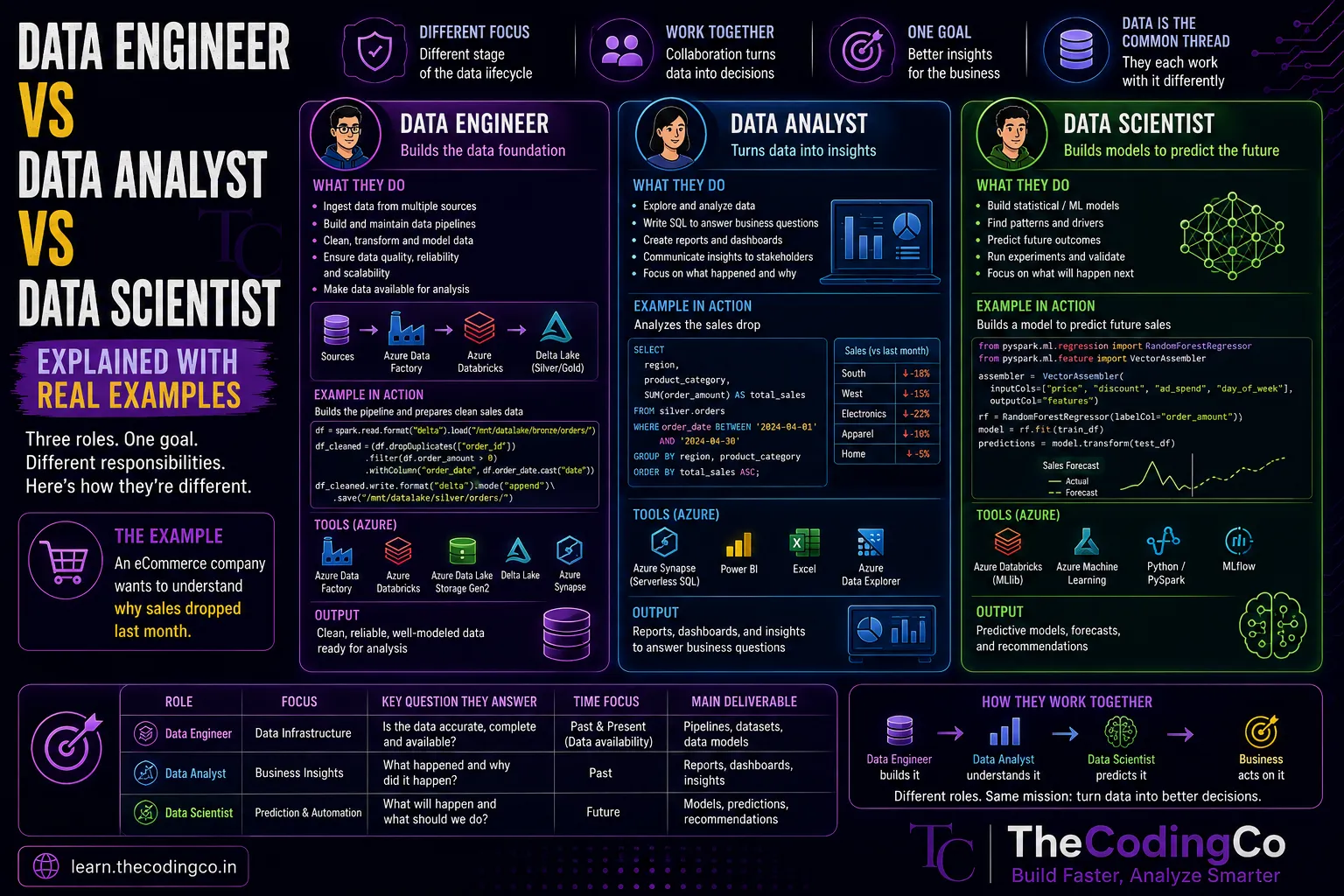
A clear breakdown of what actually separates these three roles, using one shared example, so the difference stops being confusing once and for all.
Why people mix these up constantly
If you have spent any time browsing job postings, you have probably noticed these three titles get used almost interchangeably by some companies, while other companies treat them as completely different careers. Part of the confusion is real, since the roles do overlap at the edges. But there is a clean way to separate them, and it comes down to one question. What does each person actually do with the data, and at what stage of its life do they touch it.
Let's use one shared example throughout, so the differences actually stick instead of just becoming three separate definitions to memorize.
The example: an ecommerce company wants to understand why sales dropped last month.
The data engineer
- The data engineer's job starts before anyone is even asking that question. Their responsibility is making sure sales data, customer data, and product data are reliably flowing from wherever they are generated into a place where someone can actually analyze them.
In this example, that means building and maintaining the pipeline that pulls order data from the transactional database, using something like Azure Data Factory, cleaning and transforming it using Azure Databricks, and landing it in a well structured Delta table that is fast and reliable to query.
If the sales numbers in that final table are wrong, duplicated, or missing entirely, that is a data engineering problem, and it needs to get fixed before anyone downstream can trust their analysis.
# A data engineer might write something like this
# to ensure order data lands cleanly in the Silver layer
df = spark.read.format("delta").load("/mnt/datalake/bronze/orders/")

df_cleaned = (df.dropDuplicates(["order_id"])
                .filter(df.order_amount > 0)
                .withColumn("order_date", df.order_date.cast("date")))

df_cleaned.write.format("delta").mode("append").save("/mnt/datalake/silver/orders/")
The data engineer usually never touches the actual question of why sales dropped. Their job is to make sure the data needed to answer that question is accurate and available.
The data analyst
- Once clean, reliable data exists, the data analyst is the one who actually digs into it to answer the business question.
In this example, that means writing SQL queries against the cleaned sales table, breaking down the sales drop by region, by product category, by day, trying to find a pattern.
SELECT
    region,
    DATE_TRUNC('day', order_date) AS order_day,
    SUM(order_amount) AS total_sales
FROM Silver.Orders
WHERE order_date BETWEEN '2026-07-01' AND '2026-08-31'
GROUP BY region, order_day
ORDER BY order_day;
The analyst might discover that sales dropped specifically in one region, right after a shipping delay started in that area, and then build a dashboard in Power BI showing this trend clearly so the business team can see it and act on it.
The analyst is working with the data that already exists in a usable form. They are not typically the ones building the pipeline that got the data there, and they are usually not building predictive models either. Their strength is turning existing data into a clear answer or a clear visual.
The data scientist
- The data scientist usually gets involved when the question moves from what happened to what is likely to happen next, or when a pattern is complex enough that it needs a statistical or machine learning approach rather than a straightforward SQL query.
In this example, after the analyst identifies that the shipping delay caused the drop, a data scientist might get asked to build a model predicting which future orders are at risk of a similar delay, based on factors like carrier, region, order volume, and season, so the company can proactively warn customers or adjust logistics before it happens again.
from sklearn.ensemble import RandomForestClassifier

model = RandomForestClassifier()
model.fit(X_train, y_train)  # trained on historical shipping and delay data

predictions = model.predict(X_new_orders)
The data scientist relies heavily on the data engineer having already built clean, reliable pipelines, and often works alongside analysts to understand which patterns in the data are actually meaningful before building a model around them.
Putting it together with the same example
- The data engineer built and maintains the pipeline that gets order and shipping data into a clean, trustworthy table. The data analyst used that table to figure out that a shipping delay in one region caused the sales drop. The data scientist then built a model to predict and prevent similar delays going forward.
- Notice how each role depends on the one before it. A data scientist trying to build that predictive model without clean data from a data engineer would be working with unreliable inputs from the start. An analyst without a data engineer's pipelines would be manually pulling and cleaning data themselves, which does happen at smaller companies, but is not sustainable at scale.
Where the lines blur in real companies
- At smaller companies, it is common for one person to wear more than one of these hats. A data analyst at a startup might end up writing basic ETL logic themselves because there is no dedicated data engineer yet. A data engineer at a small team might get pulled into building a simple dashboard because there is no analyst available.
- At larger companies, the lines tend to be much clearer, with each role sitting in a separate team, and formal handoffs between them, like a data engineer delivering a documented, reliable table that an analyst then builds reports from.
A simple way to remember the split
If someone is building the pipes that data flows through, that is a data engineer. If someone is asking questions of data that already exists in a usable form, and answering with queries, reports, or dashboards, that is a data analyst. If someone is building models to predict or classify something based on patterns in that data, that is a data scientist.
Interview angle
If asked to explain the difference, using a concrete shared example like this one tends to land far better than reciting dictionary style definitions. It also helps to mention the dependency chain, since it shows you understand these roles are not just different job titles doing similar work, they are actually different stages in the same overall process, each relying on the work of the one before it.
Quick recap
A data engineer builds and maintains the systems that move and clean data so it can be trusted. A data analyst uses that clean data to answer specific business questions through queries, reports, and dashboards. A data scientist goes a step further, using that same data to build models that predict or explain patterns beyond what a straightforward report can show. Each role depends on the one before it, and understanding that chain is more useful than memorizing separate definitions for each.