Data Engineer vs ETL Developer vs BI Developer, Are They the Same Job
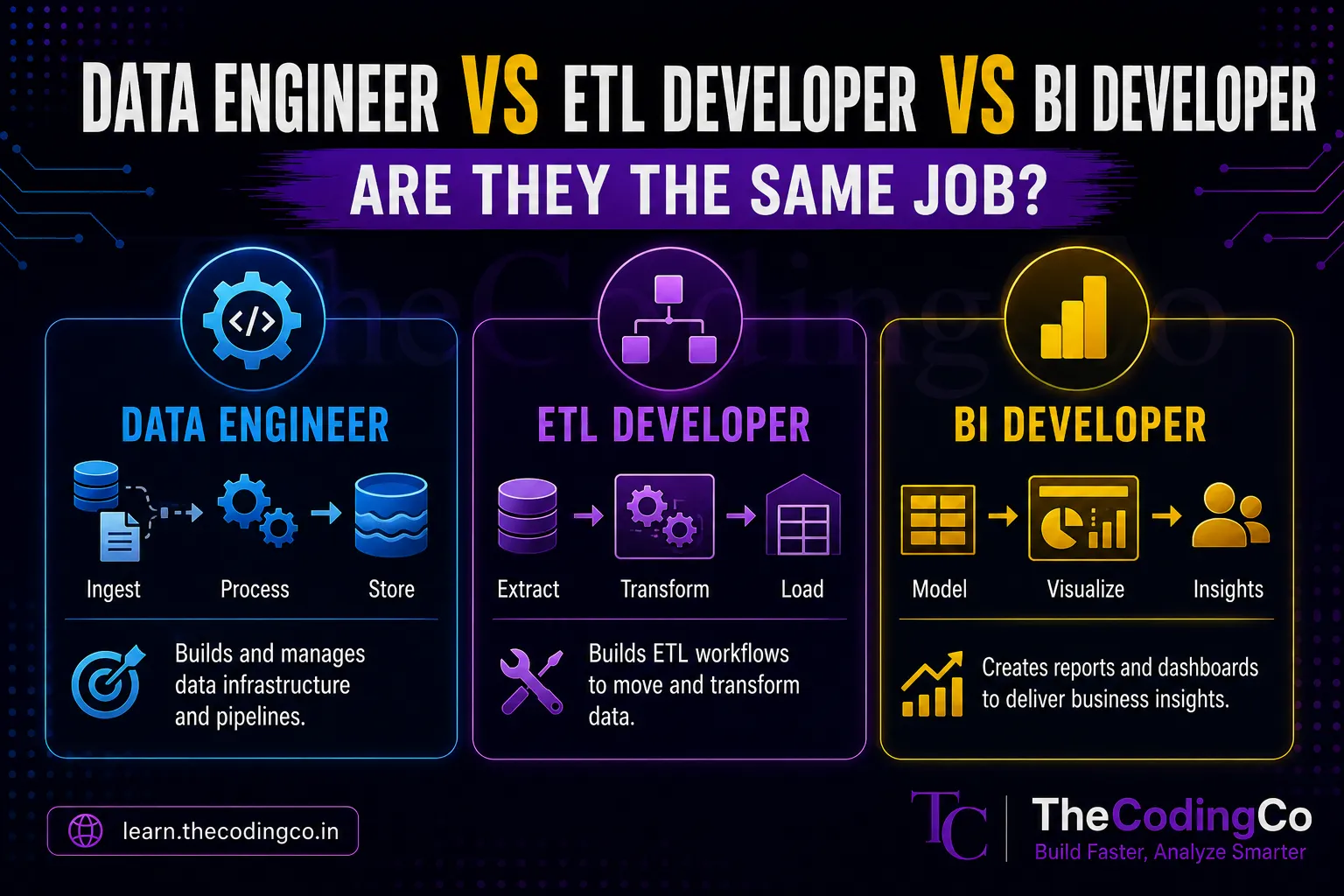
These three titles get used interchangeably a lot, but they come from different eras of data work and carry real differences in scope, worth understanding before you assume they are the same thing.
Where these titles actually come from
Unlike data engineer, which is a relatively recent title, ETL developer and BI developer have been around for a long time, going back to when most companies ran everything through traditional relational databases and dedicated ETL tools. Understanding where each title came from actually helps explain why they still show up today, sometimes describing very similar work, and sometimes describing something meaningfully different.
ETL developer
- ETL stands for extract, transform, load, and an ETL developer's job is almost exactly what it sounds like. Pull data out of a source system, apply some transformation logic to clean or reshape it, and load it into a destination, usually a data warehouse.
- Traditionally, this work was done using dedicated ETL tools like Informatica, SSIS, or Talend, which provide a visual, drag and drop way to build these extract, transform, load workflows without necessarily writing much code.
- On Azure, the closest modern equivalent to classic ETL tooling is Azure Data Factory, particularly its Mapping Data Flows feature, which lets you build transformation logic visually, similar in spirit to how older ETL tools worked, just running on Spark under the hood.
{
  "name": "ETL_CustomerOrders",
  "activities": [
    { "name": "ExtractFromSQL", "type": "Copy" },
    { "name": "TransformCleanData", "type": "MappingDataFlow" },
    { "name": "LoadToWarehouse", "type": "Copy" }
  ]
}
An ETL developer's scope is usually narrower and more focused than a data engineer's. They are typically working within an existing platform someone else set up, building and maintaining individual ETL workflows, rather than architecting the broader data platform itself. They are less likely to be writing custom Spark code, setting up cloud infrastructure, or designing an entire Medallion Architecture from scratch.
BI developer
- BI stands for business intelligence, and a BI developer's work sits at the very end of the data pipeline, focused on turning already modeled data into reports and dashboards that business users actually look at.
- A BI developer typically works with tools like Power BI, building dashboards, defining measures using DAX, and often working closely with business stakeholders directly to understand exactly what a report needs to show and how it should look.
// A typical DAX measure a BI developer might write in Power BI
Total Sales YTD =
CALCULATE(
    SUM(Sales[SalesAmount]),
    DATESYTD(Calendar[Date])
)
A BI developer generally does not build the pipelines that get data into the warehouse in the first place, and usually does not write the transformation logic that cleans raw data either. They work with data that has already gone through that process, focused specifically on presentation, usability, and making sure the numbers in a dashboard are easy for a non technical business user to understand correctly.
Data engineer
- Compared to both of these, a data engineer's scope is broader and sits earlier in the pipeline. Rather than working within a single existing ETL tool or focusing purely on the reporting layer, a data engineer is typically responsible for the overall architecture, meaning deciding how data should flow from source to destination, choosing and setting up the underlying platform, like Azure Data Factory, Azure Databricks, and Azure Data Lake Storage Gen2, and often writing custom code, usually PySpark or SQL, rather than relying purely on visual, drag and drop tools.
- A data engineer is also usually more involved with infrastructure concerns that neither an ETL developer nor a BI developer typically deal with directly, like cluster configuration, pipeline scalability, cost optimization, and setting up proper monitoring and alerting for failures.
Where the overlap actually is
- The overlap between these roles is real, and it is worth being honest about it rather than pretending the boundaries are always clean.
- An ETL developer role and a data engineer role can look almost identical at a company that has not fully modernized its data platform, especially if the ETL developer is expected to write custom transformation code and work with cloud infrastructure rather than staying purely within a visual tool. In that case, the title difference might just come down to company convention rather than an actual difference in day to day work.
- Similarly, a BI developer at a smaller company might end up doing some light data modeling work themselves, blending into what an analytics engineer would typically own at a larger company, simply because there is nobody else available to do it.
A simple way to place these roles relative to each other
Think of the full data pipeline as a line, starting at raw source systems and ending at a business dashboard. An ETL developer typically owns a segment somewhere in the middle, extracting and transforming data, often within an existing platform. A BI developer typically owns the very end of that line, turning already prepared data into something a business user can read and understand. A data engineer typically owns the broader picture, including the infrastructure and architecture that the ETL work runs on top of, and often the earlier stages of raw data ingestion as well.
Why this distinction is worth knowing, even if titles blur in practice
- Even though these roles overlap at real companies, understanding the distinction helps in two practical ways. First, it helps you read a job posting more accurately, since a posting titled data engineer that is really just describing ETL developer work, focused entirely on maintaining existing pipelines within a fixed platform, tells you something real about the scope of that specific role, regardless of the title used.
- Second, it helps in interviews, since being able to explain how your actual experience maps onto these distinctions, even if your official title was something else, shows a clearer understanding of the field than just repeating your job title back to the interviewer.
Interview angle
If asked to explain the difference between these roles, it helps to frame the answer around where each one sits along the data pipeline, from raw source to final dashboard, rather than listing tool names. Mentioning that ETL developer work tends to be narrower and more tool bound, that BI developer work sits at the very end focused on presentation, and that data engineering typically covers the broader architecture and infrastructure, shows a clear grasp of how these roles relate to each other rather than treating them as unrelated job titles.
Quick recap
An ETL developer typically focuses on building and maintaining data movement and transformation workflows, often within an existing ETL tool or platform. A BI developer sits at the very end of the pipeline, turning already prepared data into dashboards and reports for business users, usually using tools like Power BI. A data engineer typically has the broadest scope, covering architecture, infrastructure, and the earlier stages of the pipeline, often writing custom code rather than relying solely on visual tools. In practice these roles blur at many companies, but understanding the underlying distinction still helps when evaluating a job posting or explaining your own experience clearly.