What is Data Engineering, Explained in Plain Terms
A straightforward explanation of what data engineering actually means, what a data engineer builds day to day, and why this role exists in the first place.
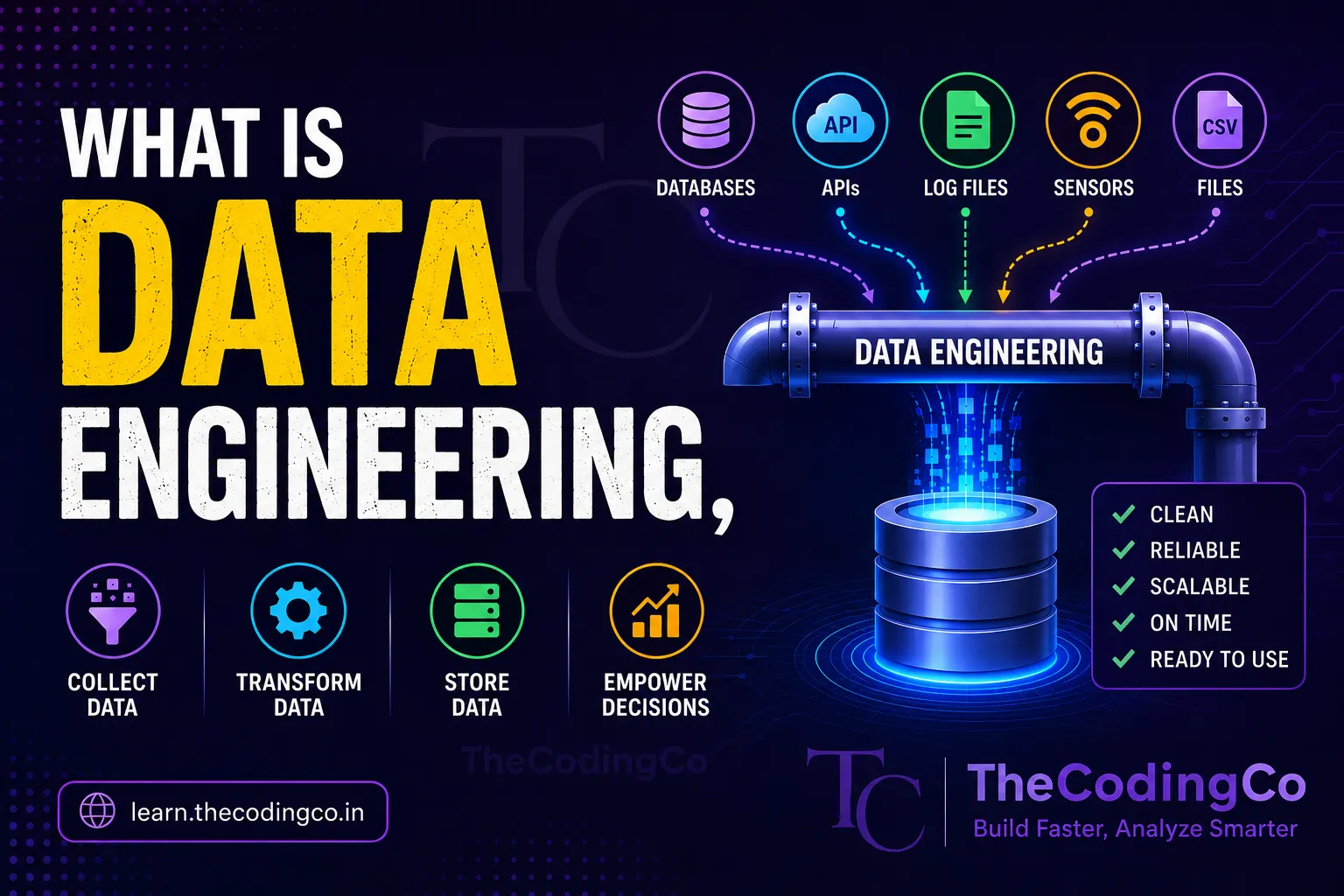
Data engineering is the work of moving data from where it is created to where people can actually use it, and making sure it arrives clean, on time, and in a usable shape.
That's really it at the core. Everything else, like ADF pipelines, Spark jobs, Delta tables, orchestration, monitoring, all of it exists to support that one basic goal. Get data from point A to point B without breaking anything along the way.
The confusing part for beginners is that this sounds simple, but the actual work behind it can get pretty deep. So let's break it down properly.
Where does the data even come from
Before you can move data anywhere, you need to know where it is being generated. In a real company, data usually comes from places like these.
- Application databases, like an ecommerce app storing orders in SQL Server
- Third party APIs, like a payment gateway sending transaction data
- Log files, like server logs or app usage logs
- IoT devices or sensors, sending readings every few seconds
- Files uploaded manually, like a vendor sending a CSV every week
None of this data is sitting neatly in one place. It is scattered, in different formats, arriving at different times. A data engineer's first job is figuring out how to reliably pull all of it together.
What a data engineer actually builds
Here is roughly what the day to day work looks like, broken into the pieces that usually confuse people early on.
Ingestion This is the process of pulling data from its source into your system. On Azure, this is usually done using Azure Data Factory, which connects to a source like a database or an API, and copies the data into storage.
Storage Once data is pulled in, it needs somewhere to live. On Azure, this is typically Azure Data Lake Storage Gen2, where raw data sits before anything is done to it.
Transformation Raw data is rarely usable as is. It might have duplicate rows, missing values, wrong data types, or it might need to be joined with other datasets. This is where tools like Azure Databricks and PySpark come in, cleaning and reshaping the data into something usable.
Orchestration All of this needs to happen in the right order, on a schedule, and needs to be retried automatically if something fails. This is handled through pipelines and triggers, again usually built in Azure Data Factory or Databricks Workflows.
Serving the data At the end, the cleaned and transformed data needs to land somewhere useful, like Azure Synapse Analytics for reporting, or a Delta table that a data scientist can query directly.
So when someone asks what a data engineer does, the honest answer is: they build and maintain the entire path data travels through, from a messy source to a clean, trustworthy table someone else can rely on.
A simple example to make this concrete
Say a retail company wants to know their daily sales by store. Here is roughly what happens behind the scenes, even before anyone sees a dashboard.
- Sales data is sitting in a transactional database, updated constantly throughout the day
- Azure Data Factory has a pipeline that runs every night, pulling the day's new records into Azure Data Lake Storage Gen2 as raw files
- A Databricks notebook runs afterward, cleaning the data, removing duplicates, and fixing any records where the store ID does not match a valid store
- The cleaned data gets written into a Delta table, organized so it is easy to query by date and store
- Azure Synapse or Power BI then reads from that table to build the actual sales dashboard
If any one of those steps fails silently, someone in the business ends up looking at a wrong number without knowing it. That is why so much of the actual job is about reliability, not just writing code that works once.
Why this role exists at all
A few years back, a lot of this work was handled by whoever was closest to the database, sometimes a data analyst, sometimes a backend developer doing it on the side. As companies started collecting data from more sources, in bigger volumes, and needing it faster, that informal approach stopped working.
Data engineering became its own role because the amount of data, the variety of sources, and the expectations around speed and reliability all grew past the point where it could just be someone's side task.
What this is not
A few common misunderstandings worth clearing up early.
Data engineering is not the same as data analysis. An analyst works with data that is already clean and asks questions of it. A data engineer is the one who made sure that clean data exists in the first place.
It is also not the same as data science. A data scientist builds models and looks for patterns. They need reliable data to do that, and a data engineer is usually the one supplying it.
Data engineering is also not just writing SQL queries. SQL is one tool among many. The bigger part of the job is designing how data flows, handling failures, and making sure things scale as data grows.
Quick recap
Data engineering is the work of building the systems that move data from scattered, messy sources into a clean, reliable form that other people in the company can actually use. On Azure, this usually involves Azure Data Factory for moving data, Azure Data Lake Storage Gen2 for storing it, Azure Databricks for cleaning and transforming it, and Azure Synapse or Power BI for serving it to the people who need it.
If you remember nothing else from this, remember that the job is not really about any single tool. It is about making sure data can be trusted by the time someone else touches it.