How to Start a Career in Data Engineering, a Complete Roadmap

A single place that answers the question almost every beginner and every career switcher asks at some point, where do I even start, what do I actually need to learn, and how do I get from zero to job ready.
Who this blog is actually for
This one is written for two kinds of people. First, someone fresh out of college, or early in their career, who has heard the term data engineering, maybe seen the salaries being talked about on LinkedIn, and wants a real answer on what to learn instead of forty different YouTube playlists that all start at a different point. Second, someone already working, maybe as a software developer, a QA engineer, a DBA, a data analyst, or even a support engineer, who wants to move into data engineering and is not sure how much of their existing experience actually carries over.
Both of you are going to read the same roadmap here, just with a slightly different starting point, and I will call out where that starting point matters as we go.
First, get the mental model right before touching any tool
Before learning a single tool, it genuinely helps to understand what the job actually is, since jumping straight into tool names without this context is exactly why so many people end up with a list of buzzwords and no real understanding of how they connect.
At its core, a data engineer moves data from where it gets created, a database, an API, a log file, to where people can actually use it, a clean table someone can query, a dashboard someone can trust. Everything you are about to learn exists to support that one job. SQL lets you query and shape data. Python lets you write logic and automate things. PySpark lets you do that at large scale, across many machines at once. Cloud tools like Azure Data Factory, Databricks, and ADLS Gen2 give you the actual platform to run all of this on in a real company.
Keep that mental picture in your head through everything below, since it turns a pile of separate skills into one connected system.
Stage 1: SQL, And Why It Comes Before Everything Else
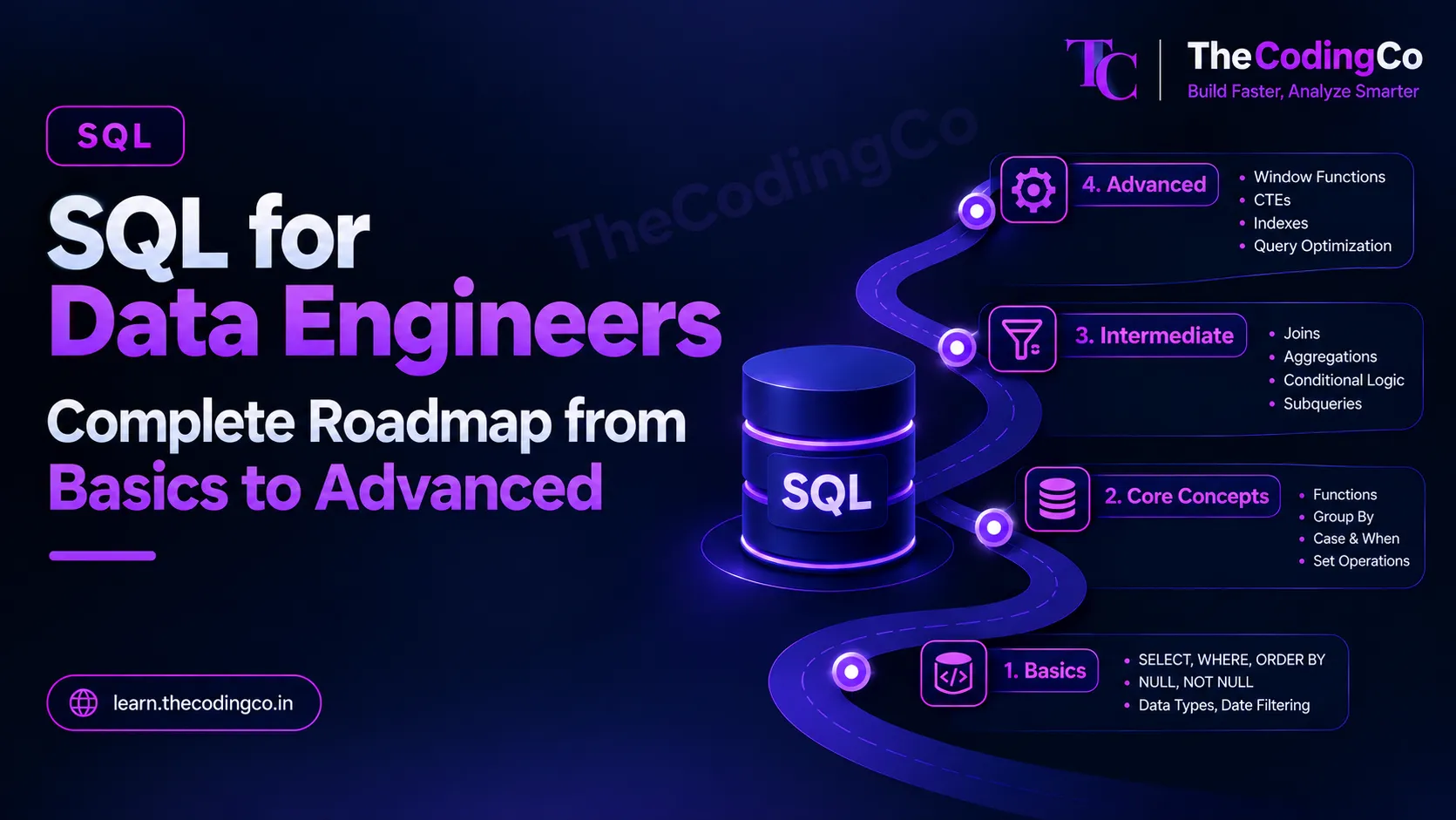
If you learn only one thing really well before anything else, make it SQL. It shows up in literally every single stage of this job, from writing transformation logic, to debugging a broken pipeline, to answering interview questions, to validating whether your own PySpark code even produced the right output.
Start with the basics properly, not just SELECT and WHERE. You genuinely need to be comfortable with joins, all of them, inner, left, right, full, and specifically the less obvious ones like semi and anti style filtering using EXISTS and NOT EXISTS, since these come up constantly in real pipeline work and in interviews.
After that, move into aggregations and grouping, then window functions, which is honestly where a lot of beginners stop practicing too early. Window functions like ROW_NUMBER, RANK, and LAG or LEAD show up in a huge number of real data engineering problems, things like finding the latest record per customer, or comparing a value to the previous row, and interviewers love asking scenario questions built entirely around these.
Once you are comfortable there, spend real time on query performance basics. Understanding what an index actually does, what an execution plan is telling you, and why a query might be slow, is a genuinely underrated skill that separates someone who can write a query from someone who can write a query that will not fall over on real data volumes.
A rough way to know you are ready to move on from this stage, you should be able to look at a messy, real looking dataset and write a query involving a join plus a window function plus an aggregation, without needing to look up syntax every single time.
See the full SQL for Data Engineers roadmap for exact topics, where each one is actually used, and how it differs across MySQL, Oracle, and PostgreSQL: SQL for Data Engineers Complete Roadmap
Stage 2: Python, Written The Way A Data Engineer Actually Uses It
Python for data engineering does not look exactly like Python for a general software developer role, and it definitely does not look like Python for a data scientist role either. You are not building web applications, and you are not primarily building machine learning models. You are writing code that reads data, transforms it, checks it, and moves it somewhere else, often with proper error handling around it.
Start with genuinely solid fundamentals, data types, loops, functions, list and dictionary comprehensions, and exception handling done properly, not just wrapping everything in a bare try except and moving on. Then move into working with files directly, reading and writing CSV, JSON, and Parquet files, since this is a huge part of real pipeline work, especially early on before everything moves into Spark.
From there, get comfortable with pandas for smaller scale data manipulation and cleaning, since a lot of quick validation work, one off analysis, and small scale transformation still happens in pandas even at companies that are heavily on Spark for their production pipelines.
Also spend deliberate time learning how to structure code properly, functions with a single clear responsibility, meaningful variable names, and basic logging instead of scattering print statements everywhere. This sounds like a small thing, but it is genuinely one of the first things that separates someone who can write a working script from someone who can write code a team can actually maintain.
See the full Python for Data Engineers roadmap for exact topics, real scenarios for each one, and where your gaps likely are based on your background: Python for Data Engineers Complete Roadmap
Stage 3: Understanding Data Itself, Before Jumping Into Big Data Tools
This is the stage a lot of people skip completely, and it usually shows up later as a gap that is hard to explain in an interview. Before learning PySpark or any cloud tool, understand how data is actually organized and modeled.
Learn what a data warehouse is, and how it is different from a plain database that runs an application. Learn what dimensional modeling means, fact tables, dimension tables, and how a star schema is actually laid out and why it is built that way. Learn slowly changing dimensions properly, at minimum Type 1 and Type 2, since these two alone come up in an enormous number of real interviews and real pipelines. Understanding the Medallion Architecture pattern, Bronze, Silver, and Gold layers, and why data gets progressively cleaned and refined through these stages rather than being transformed in one giant step, also belongs here.
None of this requires a single cloud tool yet. This is conceptual, and it is genuinely one of the highest value things you can learn early, since it shapes how you think about every pipeline you build afterward.
Stage 4: PySpark, Thinking In Distributed Terms
Once SQL and Python fundamentals feel solid, PySpark is the natural next step, since this is where you start handling data at a scale a single machine genuinely cannot process efficiently on its own.
Start by understanding why Spark exists in the first place, the idea of distributing data and computation across many machines instead of one. Learn DataFrames properly, reading and writing different file formats, filtering, joins, and aggregations, all of which will feel familiar if your SQL foundation is genuinely solid, since PySpark's DataFrame API mirrors SQL concepts closely.
Then go a level deeper into how Spark actually executes your code underneath. Learn the difference between a transformation and an action, and why Spark is lazy about running anything until an action actually forces it to. Learn what a shuffle is, why it is expensive, and how something like a broadcast join can avoid one entirely for smaller datasets. Get comfortable reading a physical execution plan using explain, even at a basic level, since this is exactly the kind of thing that separates someone who has only run tutorials from someone who has actually debugged a real slow pipeline.
Delta Lake deserves specific attention here too, since most real Azure Databricks work happens on Delta tables rather than plain Parquet. Learn how MERGE works, since it is central to implementing things like SCD Type 2 properly, and learn the basics of how Delta handles versioning and time travel.
See the full PySpark for Data Engineers roadmap for exact topics, real scenarios for each one, and how it builds on your SQL and Python foundation: PySpark for Data Engineers Complete Roadmap
Stage 5: Picking A Cloud Platform And Actually Going Deep On It
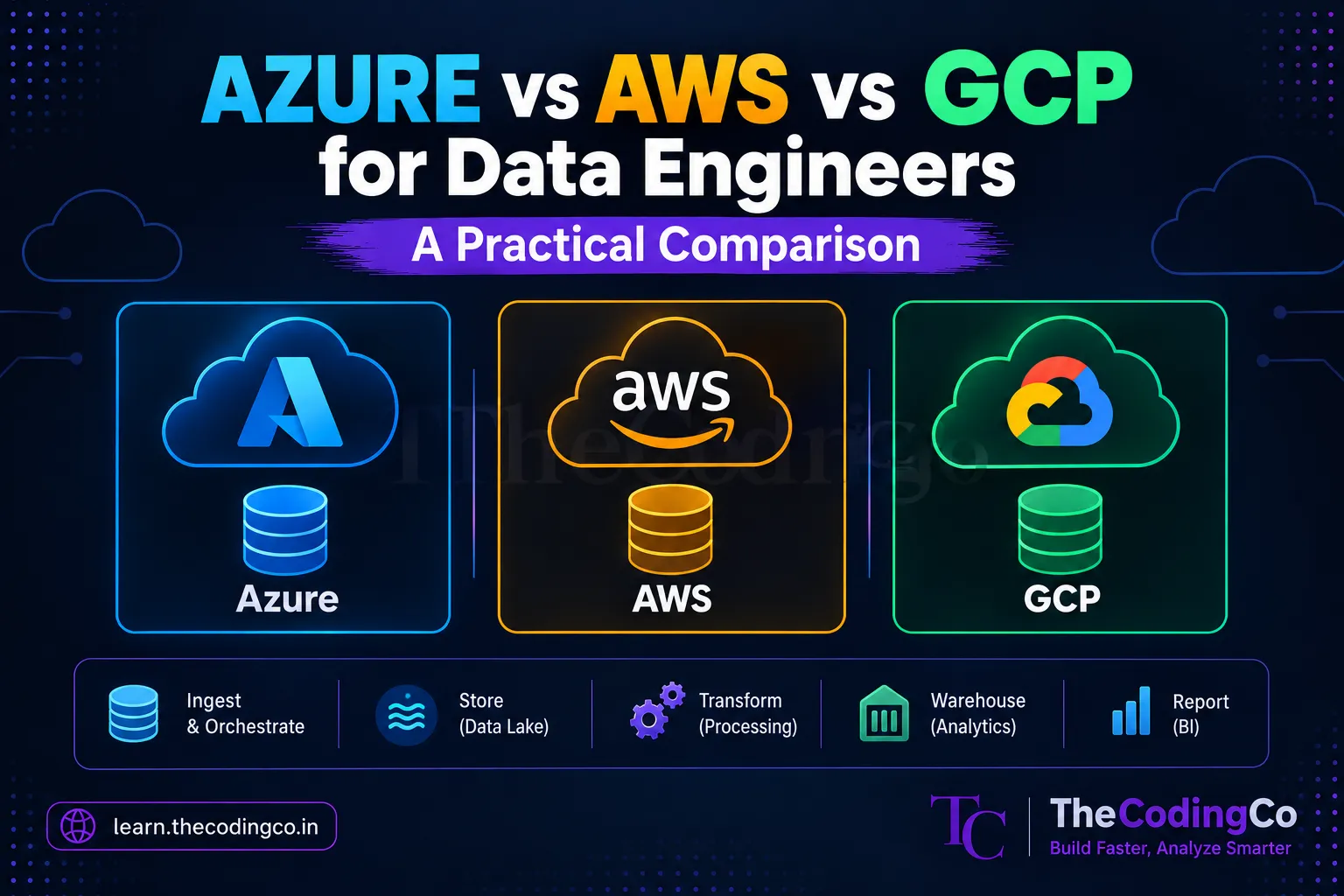
At this point you need to pick a cloud ecosystem and commit to it rather than spreading yourself thin across all three major clouds at a surface level. Azure, AWS, and GCP all do fundamentally similar things, so once you genuinely understand one deeply, picking up another later is meaningfully faster.
If you go the Azure route, which is extremely common for data engineering roles, especially in India, the core stack usually looks like this. Azure Data Factory for ingestion and orchestration, Azure Data Lake Storage Gen2 as your central storage layer, Azure Databricks for the actual transformation work using PySpark, and Azure Synapse Analytics or Power BI on the serving side. Learn each one not as an isolated fact, but by building one full pipeline that actually uses all of them together, since that is the only way the tools genuinely start making sense as a connected system rather than a list of names.
Alongside this, learn the basics of cloud security concepts that show up constantly in real production work, things like Azure Key Vault for storing credentials safely, and Managed Identity for letting services authenticate to each other without hard coded secrets sitting in your code.
See the full Azure for Data Engineers roadmap for exact services, how they connect in one real pipeline, and how they map onto AWS, GCP, or on premises tools: Azure for Data Engineers Complete Roadmap
Stage 6: Orchestration, Version Control, And The Habits That Make You Look Production Ready
A few smaller but genuinely important pieces tend to get skipped by self taught learners, and they are exactly the kind of thing that shows up in an interview when someone asks about your actual pipeline experience.
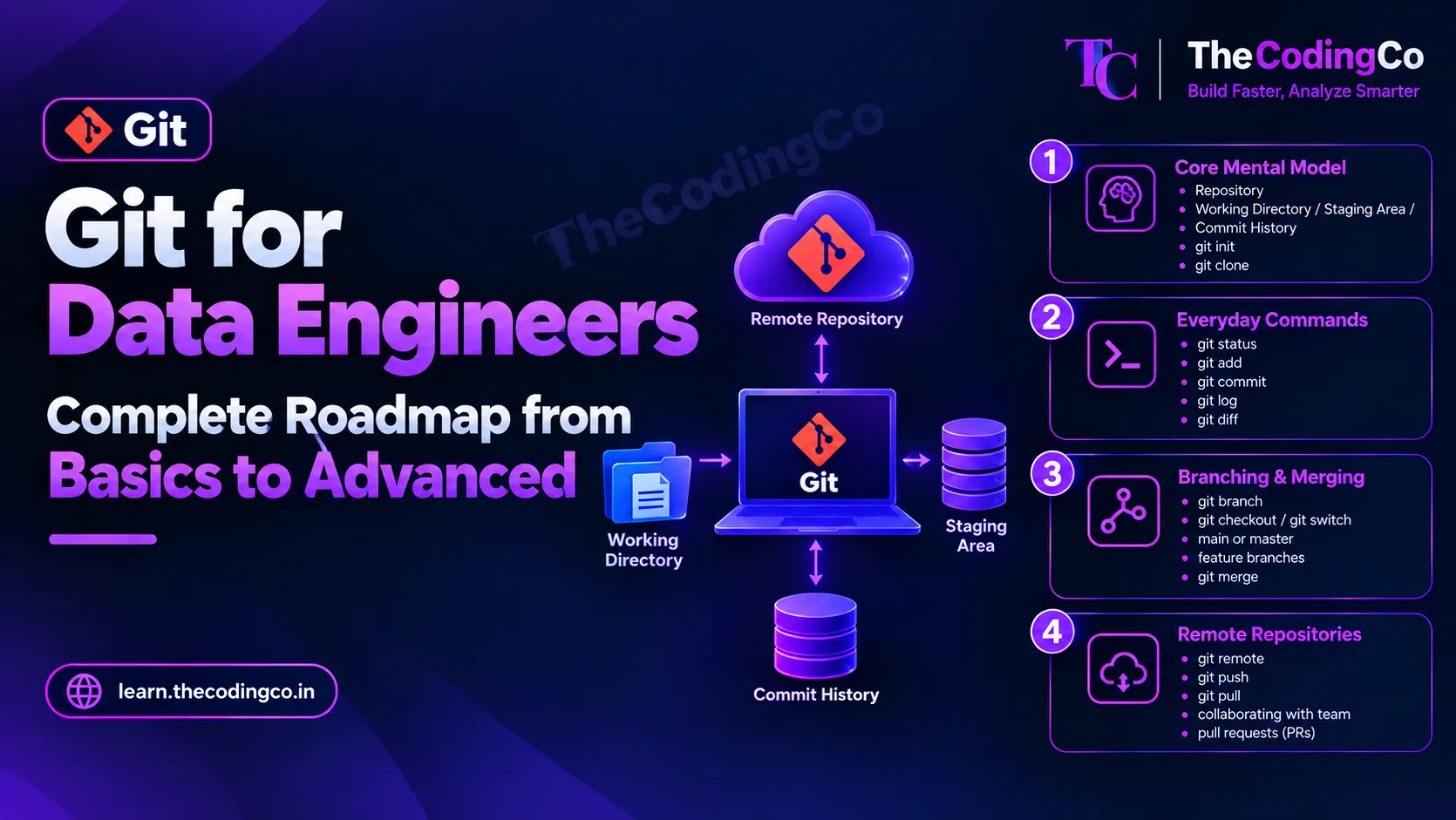
Learn Git properly, not just enough to push code, but enough to work comfortably with branches, pull requests, and resolving a merge conflict without panicking. Learn the basics of scheduling and orchestration, whether that is through Azure Data Factory triggers, Databricks Workflows, or a tool like Apache Airflow, since almost no real pipeline runs manually every single day. Learn what monitoring and alerting actually mean in this context, since a pipeline that fails silently is arguably worse than one that fails loudly, and being able to talk about how you would catch that failure early is a genuinely strong signal in an interview.
See the full Git for Data Engineers roadmap for exact commands, the real collaboration workflow, and how Git connects directly to Data Factory and Databricks: Git for Data Engineers Complete Roadmap
Building projects that actually demonstrate something
A portfolio full of tiny disconnected scripts does not really show much. What genuinely helps is building two or three complete, end to end projects that show the full picture, from a messy raw source all the way to a clean, usable table or dashboard.
A strong first project looks something like this. Pick a realistic dataset, retail sales data, ecommerce orders, or transaction data all work well. Simulate raw data landing in a Bronze layer, clean and deduplicate it into a Silver layer using PySpark, build proper fact and dimension tables in a Gold layer using a star schema, and implement at least one slowly changing dimension properly, ideally Type 2, using a real Delta MERGE. Orchestrate the whole thing so it runs on a schedule rather than requiring you to manually trigger each step. If you can, connect the final Gold layer tables to a simple Power BI dashboard, since this shows you understand the entire pipeline rather than just the transformation piece in the middle.
A second project worth building specifically demonstrates data quality thinking, something like a pipeline that deliberately ingests messy data, duplicate records, missing values, orphaned foreign keys, and then actually detects and handles each of these issues explicitly, using patterns like a left anti join to find orphaned records, rather than quietly ignoring them.
Document both projects properly on GitHub, with a clear README explaining the architecture, the decisions you made, and why. Interviewers genuinely do look at this, and being able to walk through your own project confidently is one of the strongest things you can bring into an interview.
If you are switching domains with existing experience
If you are coming from another field entirely, the good news is you are probably not starting from zero, even if it does not feel that way yet.
If you are coming from software development, your programming fundamentals and your comfort with Git and structured code are a real head start, you mainly need to build depth in SQL, distributed data concepts, and the specific cloud tools used in data engineering. If you are coming from a QA or testing background, your instinct for thinking about edge cases and data quality is genuinely valuable in this field, and you should lean into that specifically when talking about your experience. If you are coming from a DBA role, your SQL depth is likely already strong, and you mainly need to build up Python, PySpark, and the broader pipeline and cloud side of things. If you are coming from a data analyst role, you likely already understand the business side of data well, and your gap is usually more on the engineering and infrastructure side, things like orchestration, distributed processing, and pipeline reliability.
In every one of these cases, be honest and specific in interviews about what your actual experience maps to, rather than trying to make your old title sound like it already was data engineering. Saying something like, I have three years of strong SQL and database experience as a DBA, and I have spent the last six months building PySpark and Azure pipeline projects to move into data engineering, is a genuinely strong, honest framing that most interviewers respond well to.
How to actually prepare for interviews, stage by stage
Data engineering interviews generally test a few distinct things, and it genuinely helps to prepare for each one separately rather than treating interview prep as one big vague bucket.
SQL rounds usually involve a live query on a sample dataset. Practice writing queries under mild time pressure, out loud if possible, explaining your thinking as you go, since interviewers care as much about how you reason through a query as the final syntax. Focus specifically on joins, window functions, and a few classic problems like finding duplicates, finding the second highest value per group, or finding gaps in a sequence of dates.
Python or coding rounds often involve either general logic questions, or, more specifically for this field, questions around processing and transforming a small dataset, sometimes given as a list of dictionaries or a small CSV. Practice writing clean, readable code under time pressure, and practice explaining your approach before you start typing, since jumping straight into code without a plan tends to visibly slow people down under pressure.
PySpark and scenario rounds tend to ask you to reason through a described pipeline problem rather than write full code from scratch. Expect questions like, how would you handle duplicate records arriving from a source system, how would you implement Type 2 history for a dimension table, or why would a specific join be slow and how would you fix it. Being able to explain broadcast joins, shuffles, and basic Delta MERGE logic clearly and confidently covers a large share of what actually gets asked here.
Architecture or design rounds, more common for people with a few years of experience, ask you to design a full pipeline for a described business scenario. Practice this specifically by talking through your own portfolio projects out loud, and then trying a few completely new scenarios cold, explaining your thinking on ingestion, storage, transformation, and serving, exactly the same mental model from the very start of this blog.
Behavioral rounds are where your actual project stories matter most. Have two or three real stories ready, a time a pipeline broke and how you found the root cause, a time you had to make a trade off between doing something quickly versus doing it properly, and a time you had to explain a technical decision to someone non technical. These come up far more often than people expect, and having them ready genuinely changes how confident you sound.
A realistic way to practice daily instead of just watching content
Watching tutorials feels productive, but it rarely builds the kind of muscle memory an interview actually tests. A better daily habit looks something like this. Spend real time writing SQL against an actual dataset, not just reading solved examples, ideally on a platform where you can check your own output. Spend time each week extending your own portfolio project rather than starting a new one from scratch every time, since depth on one real project teaches you far more than five shallow ones. Read one real pipeline failure scenario or one interview style question a few times a week, and actually write out your reasoning, even if nobody is grading it, since forcing yourself to articulate an answer is a completely different skill than passively understanding one.
A rough timeline, so this does not feel endless
If you are starting from genuinely nothing and studying consistently, a realistic path looks something like three to four months building genuinely solid SQL and Python fundamentals, followed by two to three months on PySpark and data modeling concepts, followed by two to three months going deep on one cloud platform while building your first full project. Somewhere around the seven to nine month mark, with a couple of solid projects and consistent SQL and PySpark practice behind you, most people are genuinely ready to start applying and interviewing seriously, though this obviously varies depending on how much time you can dedicate each week and whatever background you are coming from.
If you already have strong SQL or programming experience from another role, this timeline compresses meaningfully, sometimes to as little as three to four months total, since you are filling specific gaps rather than starting from zero.
Common mistakes worth avoiding
A few patterns show up again and again in people who take much longer than necessary to become job ready. Jumping straight into PySpark and cloud tools before SQL fundamentals are genuinely solid, which leads to shaky performance in exactly the interview round most companies test first. Collecting certificates instead of building projects, since a certificate proves you sat through content, not that you can actually build something. Building five shallow, disconnected scripts instead of two or three complete, well explained projects. And treating interview preparation as something separate from learning, rather than practicing the actual skill of explaining your reasoning out loud from day one.
Interview angle
If asked how you prepared for a data engineering role, walking through this exact structure, strong SQL and Python foundations first, then data modeling concepts, then PySpark and distributed thinking, then depth on one specific cloud platform through real projects, shows a genuinely deliberate, structured approach rather than a scattered one. This framing alone tends to stand out, since a large number of candidates can name the tools but cannot explain why they learned them in that order or how the pieces connect to each other.
Quick recap
Start with SQL, genuinely mastering joins and window functions, since it underlies everything else in this field. Build solid Python fundamentals focused on data handling rather than general software development. Understand data modeling concepts, dimensional modeling, slowly changing dimensions, and the Bronze, Silver, Gold pattern, before touching big data tools. Move into PySpark with a real understanding of how Spark executes code underneath, not just the DataFrame syntax. Pick one cloud platform and go genuinely deep on it through a complete, end to end project rather than shallow tool familiarity across several clouds. Build two or three well documented, complete projects instead of many small disconnected ones. Prepare for interviews stage by stage, SQL, coding, PySpark scenarios, architecture, and behavioral, practicing each distinctly. And if you are switching domains, be honest and specific about what your existing experience actually maps to, rather than trying to force fit an old title into a new one. Follow this in order, stay consistent, and this field genuinely does become learnable step by step rather than an overwhelming pile of buzzwords.